Student loan payoffs, consolidation, and Income-Driven Repayment

If consolidating, choose the ‘let my loan servicer pick my repayment plan’ option to get the lowest payment out of the four Federal student loan repayment programs. Your interest rate for direct Federal loans will just be the weighted average of your existing loans, which makes sense. Consolidating also ends your grace periods, FYI, so make sure that’s not a problem for you.

If your loans are all Federal, you’ll still get the same ‘credit’ towards PSLF (Public Service Loan Forgiveness, the 10 year– 120 months of payments made– debt forgiveness you get for working for a non-profit or government entity. Because, ya know, you can’t work for the public good at a for-profit institution where people engage in voluntary transactions for their mutual benefit…)

Your Income-Driven Repayment payment will never be larger than the standard 10 year payoff plan, per this: https://studentaid.gov/manage-loans/repayment/plans/income-driven

You can simulate your new loan payment here: https://studentaid.gov/loan-simulator/

Your strategy for student loans should be to (1) get the lowest payment (and effective interest rate) possible then (2) pay the minimum due and hope for them to get forgiven either under PSLF or some future Democratic policy. Or if your rates are actually pretty high (say, > 6-7%, and this is calculating the true rate AFTER the IDR payment is reducing your standard repayment), paying them off (God forbid you should be expected to do that!)

Parent Plus Loans

Direct PLUS Loans for Parents are loans where the parent of the student takes on the debt, not the student. The rate is fixed for the life of the loan, and you must also pay a fee as a % of the loan (4.228% as of writing for loans disbursed after 2020) that comes out of the balance you receive.

Parent PLUS Loans have the following repayment term options:

  • Standard Repayment Plan: Under the Standard Repayment Plan, the borrower makes fixed monthly payments for up to 10 years.
  • Graduated Repayment Plan: Under the Graduated Repayment Plan, the parent makes payments for as many as 10 years. However, the plan starts with lower monthly payments that increase every two years.
  • Extended Repayment Plan: The Extended Repayment Plan allows borrowers to repay their loans over an extended period of as much as 25 years.

You can defer repayment until after the student graduates, but the interest still accumulates. Parent PLUS Loans are eligible for forgiveness under Public Service Loan Forgiveness (PSLF) and the Income-Contingent Repayment plan.

The are NOT discharged during bankruptcy.

“Repayment options for parent PLUS loans

There are some important differences between parent PLUS loans and private student loans — and your repayment options are a key factor.

Parents have many options to repay their PLUS Loans and can even change their repayment program over time. Here are some of the different ways parents can choose to pay off their federal debt:

Income-Contingent Repayment: Parents can gain access to the Income-Contingent Repayment plan if they consolidate their federal student loan debt. It caps payments at the lesser of 20% of your discretionary income divided by 12 or the amount you’d pay in fixed monthly payments on a 12-year repayment plan, adjusted based on income.”

*For ICR, discretionary income is generally your AGI – 100% of the Federal poverty threshold [1$15,600 for the lower 48 states in 2025] * by the percentage (20%): https://www.nerdwallet.com/article/loans/student-loans/discretionary-income-calculator

“One workaround for the fixed payments and ineligibility for loan forgiveness is to use a Direct Consolidated loan. That requires rolling the Direct PLUS loan into a new, bigger loan — possibly with a higher interest rate.

That loan would be eligible for income-contingent repayments and could be forgiven after 25 years of payments. Parents who qualify under the Public Service Loan Forgiveness program will be able to apply after 10 years of payments.”

Parent Plus Loans are discharged (cancelled) upon death: https://studentaid.gov/manage-loans/forgiveness-cancellation/death

Consolidation and income-driven repayment

Income-contingent repayment plans: Monthly payments are capped at 20% of your discretionary income. After 25 years of on-time payments, the balance is forgiven. This can be a good option if you’re approaching retirement since many retirees have limited income. Your payments could be $0 in some circumstances. You’ll need to consolidate your loans to qualify for this option.

Extended repayment plan: The standard repayment term for federal student loans is 10 years, but an extended repayment plan stretches the repayment period to 25 years. Of course, the longer repayment term causes you to pay more interest.”

Married Filing Separately trick for married couples to reduce your IDR payments

If you have the student loan debt AND you make significantly less than your spouse AND you do NOT live in a community property state (like Washington, Wisconsin, and California; this is because your income will just be half your total income as a couple), you might be able to significantly reduce your student loan payment under an IDR like IBR or RAP. If you are on a Public Service Loan Forgiveness (PSLF), artificially lowering what you have to pay might result in far higher forgiveness later.

Compute the savings on student loans vs any extra taxes you will pay/cost of tax benefits you will miss out on from switching from Married Filing Jointly to Married Filing Separately (MFS). Use your tax software or ask your accountant to model your taxes under each scheme to compute the difference on the tax front.

Calculate any extra taxes you’ll pay vs filing jointly

  • Lost Deductions & Credits: You lose eligibility for benefits like the student loan interest deduction, adoption credits, and certain education credits.
  • Higher Tax Brackets: The MFS tax brackets are less favorable than Married Filing Jointly (MFJ), meaning your combined household tax bill will likely increase.
  • Retirement Limitations: The income phase-out limits for contributing directly to a Roth IRA drop to almost zero when filing separately.

Filing an extension to delay IDR increases when your income goes up

Another trick, as described here, is to file an extension on your taxes in the tax year that your income went up so that your prior year income is used when it comes time to recertify your income for FAFSA’s IDR repayment plan.

From that article:

“Consider a physician with $300,000 in student loans at 6.5% interest. They’re pursuing Public Service Loan Forgiveness (PSLF) and filing taxes separately from their spouse to keep payments based on their income alone.

Their 2024 tax return reflects residency income of $80,000. On the Income-Based Repayment (IBR) Plan, that works out to roughly $400 per month. But this year, they transitioned to attending, earning a blended income of about $165,000 for 2025 — moving to $250,000 in full-year attending salary by 2026.

Here’s how the timing plays out:

Tax ScenarioIncome Used for RecertificationMonthly Payment
File 2025 taxes on time (April)$165,000 (blended year)$1,103
File extension (recertification pulls 2024 return)$80,000 (residency income)$400

That’s a difference of over $700 per month (more than $8,400 per year) just by strategically extending your tax filing deadline. If you’re pursuing PSLF, that’s $8,400 more that gets forgiven rather than you paying it out of pocket.

The system only links to what’s been officially filed. When extensions are used consistently year over year, your payment stays approximately 12 to 18 months behind your actual current income.”

This strategy only works if your annual IDR recertification date falls between April 15 and October 15.

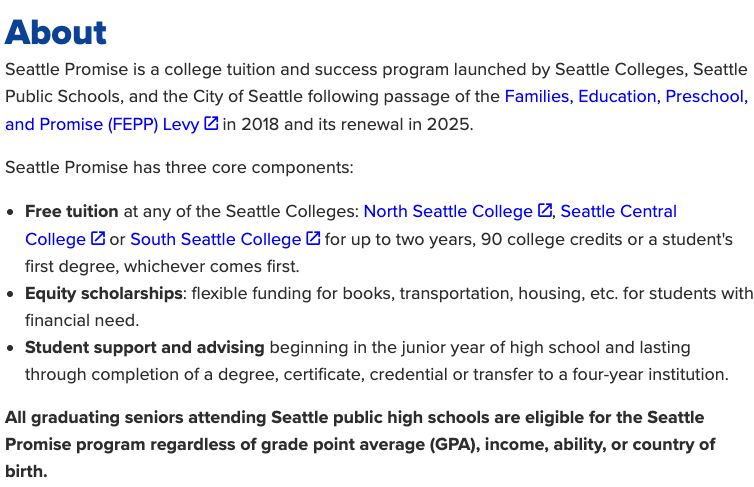
All Seattle public high school students can get the first 2 years of Seattle Colleges tuition for FREE!

If your kids go to a Seattle public high school, they can attend one of the Seattle Colleges tuition-free for the first two years of school.

Tuition & fees for years 3 and 4– if continuing on for a Bachelor’s and not stopping at an Associate’s degree– are roughly $27,000/year* as of 2026. There are other Seattle Colleges scholarships too.

Seattle Promise is the program that sponsors this via a tax levy that run for 6 years starting in June 2026 (so expiring unless voters renew in June 2032.) Read more about it here.

The Washington College Grant— something you are automatically considered for when completely FAFSA (or WAFSA for those without legal US residence status like ‘Dreamers’ or undocumented immigrants)– is another option for Washington state residents outside of Seattle.

*Data as of June 2026. Three 15 credit quarters is a full year, so multiply the below by three to get annual tuition & fees:

Student Residency StatusAnnual Tuition (15 credits/quarter)Approximate Mandatory FeesTotal Expected Annual Cost
WA State Resident$8,131.35$663$8,794.35
Non-Resident (U.S. Citizen)$8,729.10$663$9,392.10
International Student$22,487.40$663$23,150.40

Screenshot of the programs’ description. The same link has a list of eligible Seattle high schools:

How to pay estimated Federal income taxes to the IRS via Direct Pay

If you have small business income or other income that you haven’t properly withheld taxes for, you need to make estimated tax payments to the IRS to avoid an ‘underwithholding penalty’ at the end of the year.

You are supposed to make these payments quarterly, by the 15th of the 3rd month of the quarter (e.g.: March 15th, June 15th, Sept 15th, Dec 15th.)

Method 1 – With an IRS account (recommended!)

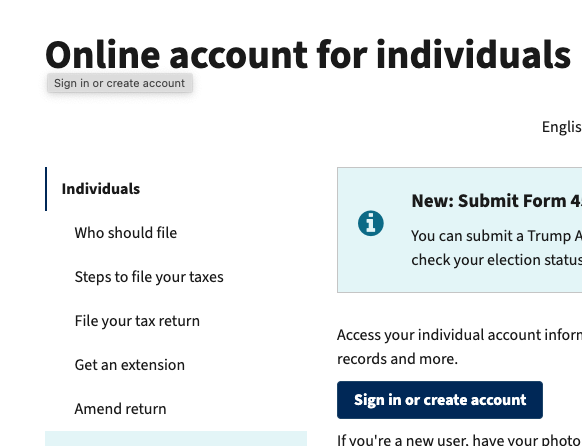
The IRS has instituted a system where you can create an account to track your filings, payments, etc. Create an account and a login with ID.me from here: https://www.irs.gov/payments/online-account-for-individuals

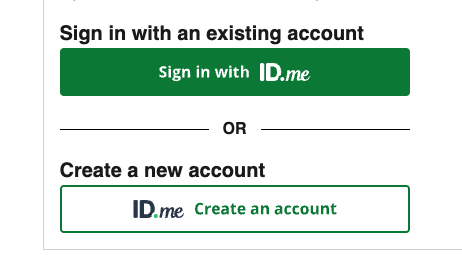
Either sign in if you already have an IRS ID.me account (I forget if you can use an id.me account associated with another government service: worth a try), or create one:

From here you can click ‘Make a Payment’, as well as view past payments (very helpful at tax time, but I would still recommend writing down all your estimated payments separately and putting that in your tax folder so that you remember at filing time.)

Enter your payment info:

Choose the bank account you want to pay from, including one you might have already linked. Then, hit ‘Submit’!

I print my confirmation just to be paranoid. Never trust the guv’ment! 🙂

Method 2 – No IRS account

First, go to the short url irs.gov/directpay, or directly to irs.gov/payments/direct-pay-with-bank-account:

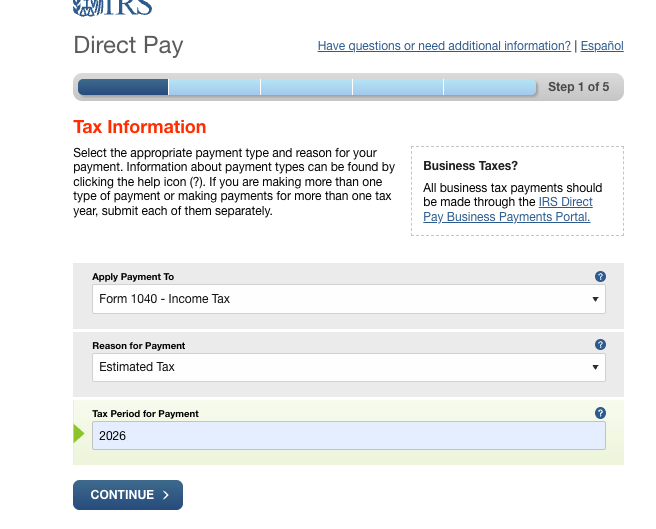
Click ‘Pay Individual Tax’, then fill out the form as shown below (1040, Estimated Tax, and the current tax year, presumably):

Fill out all the identify verification stuff:

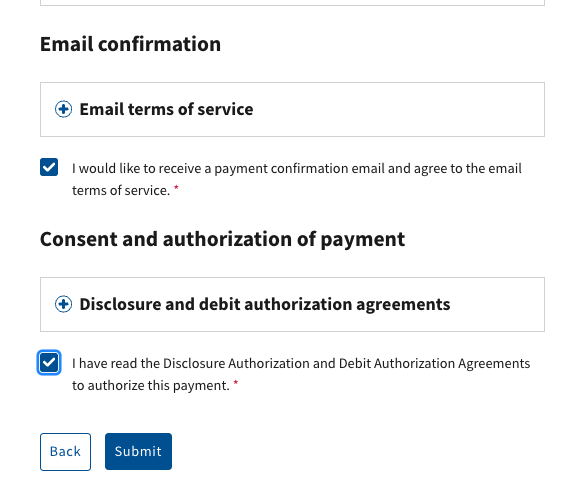
Fill out how much you want to pay, and make sure to check the email confirmation box. Separately, LOG WHAT YOU PAID and for what tax year, and file it in your tax folder so that you remember to enter it into your tax software to state that you withheld more. The IRS does NOT remind you of your estimated payment, so you’ll want to remember it at tax time!

Then, enter your name & social to digitally sign, and hit ‘Submit’. Success!

How to get your GRMS radio license ($35 for 10 years for the whole family!)

GRMS bands are fixed channels (frequencies) that can also be accessed via (unlicensed) handheld walkie-talkies (called the ‘FRS’, Family Radio System.) GRMS has it’s own ‘repeater’ (longer-range, for our purposes here) channels. Ham radio operators usually will have handsets, such as the Baofeng UV-5R+, that can access these frequencies as well, but you need to confirm whether you’re legally allowed to broadcast on them from whatever device you choose. You can get a GRMS-certified device to be safe.

Check your license for details on whether you’re allowed to broadcast, aka talk, on whichever radio bands you’re interested in. Anyone can listen without a license.

Why get a GRMS radio license?

For $35 for no test, you, your spouse, your kids, and even your grandparents are covered to broadcast on the GRMS frequencies. It could be a great way to keep in touch if cell service is ever out, and it’s a lot of fun! Note that all communications are required to be unencrypted, so assume anything you say over the airwaves can be heard by anyone else in range who happens to be listening in to that frequency.

GRMS Transmitting (talking) Rules

Per this:https://www.rightchannelradios.com/pages/gmrs-licensing-information

  •  If an authorized FCC representative request to inspect a GMRS station (this means anything GMRS: handheld, mobile unit, base units, etc), the operator must make the station and any station records available
  •  No messages in connection with any activity that is against Federal, State, or local law
  •  No false or deceptive messages
  •  No coded messages with hidden meanings (“10 codes” are allowed)
  •  No music, whistling, sound effects or material to amuse or entertain
  •  No ads or offers for the sale of goods or services
  •  No ads for political candidate or political campaign
  •  No international distress signals (i.e. Mayday) unless in a vehicle in immediate danger
  •  No communicating with stations in the Amateur Radio Service, any unauthorized station, or to any foreign station
  •  No continuous or uninterrupted transmissions (unless communications have to do with the immediate safety of life or property)
  •  No messages for public address systems
  •  Must identify using FCC-assigned call sign at the end of transmissions and at periodic intervals during transmissions [BTF editor’s note: This is true for any family members operating under your GRMS license.]

How to get it (set aside 30 minutes to complete because the FCC website is so convoluted…)

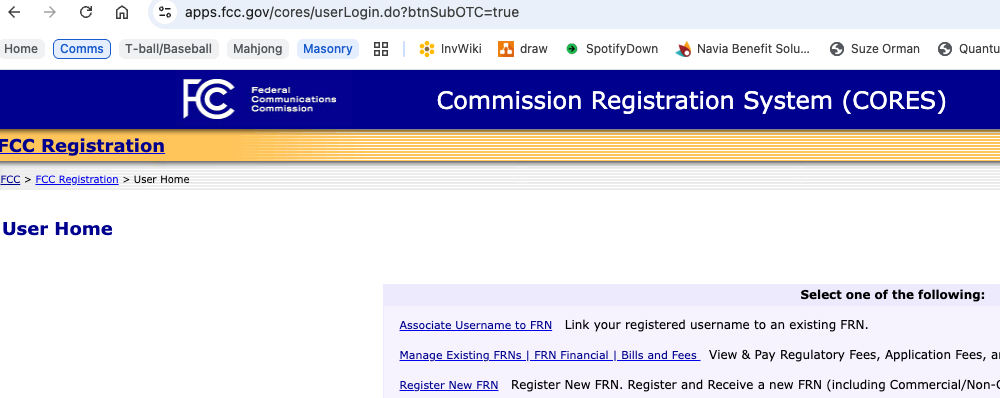
Navigage to the FCC’s login page. Create an account if you don’t already have one. (Ham radio operators can login with their existing credentials.)

Select ‘Register a new FRN’:

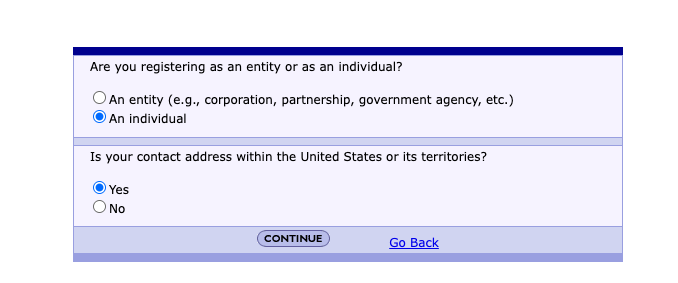
Mark ‘individual’, assuming you are registering as one:

If you’ve been licensed by the FCC before for something else (i.e.: ham radio): Agree that you’re creating another one for your same social security number.

Once you get your new FRN number– WRITE IT DOWN (you’ll need it later! If you forgot to, login on a separate tab and navigate to ‘Manager FRNs’ to see the ones associated with your FCC CORES profile)–click ‘ULS’ to continue at the bottom of the page:

If you receive an error like the one below, try hitting the ‘back’ button on your browser and trying again to click the ‘ULS License Manager’ (worked for me):

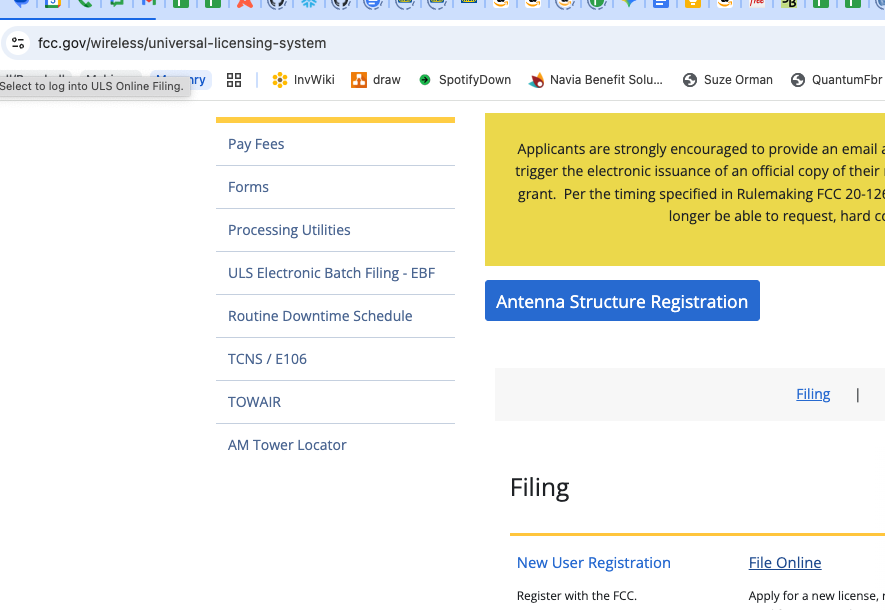
Find ULS again: https://www.fcc.gov/wireless/universal-licensing-system , then click ‘File Online’:

‘Apply for a new license’:

Scroll all the way down in the list to ZA – GRMS, and ‘Continue’:

Leave the questions as ‘No’ and fill out your name & address (again…)

Answer ‘no’ to the felony question. (Not sure what happens if you have to say yes. Google it!)

‘Continue to Certify’ > ‘Submit Application’ after adding your name once more. ‘Continue to CORES for Payment’, then (amazingly), you have to re-login AGAIN and figure out how to pay:

Click ‘FRN Financial’:

‘View/make payments’ next to your GRMS FRN number to the right:

‘Make payment’:

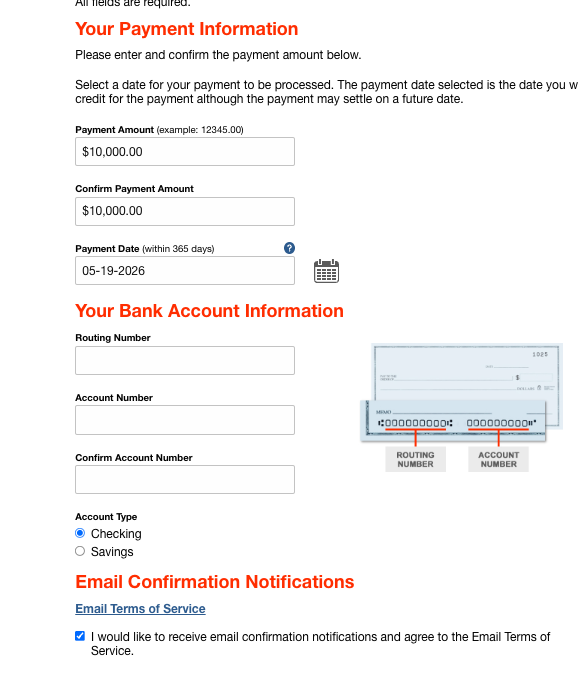
Choose your GRMS FRN, and link your bank account or credit card to pay!

Finally, you did it! Now kick back and wait for the FCC to email your license & call sign info. Use that call sign when transmitting on GRMS bands.

What radio to use?

Baofeng is the prepper/cheapo choice for ham enthusiasts, and it looks like they make GRMS-certified versions of their ‘standard’ UV handset. That said, these will be extremely limited IF you also plan on getting or have your ham license. It appears that the broad-based ham Baofengs (ex: UV-5R+) WOULD work just find and be compliant with the requirements for GRMS EXCEPT they are NOT actually certified, and thus aren’t legal to use per the FCC’s rules (part 95E certification.) (Disclaimer: not a lawyer!) Instead, you would need a Baofeng UV-5G+ or similar (‘G’ seems to be their ‘GRMS-certified’ clue for all models.)