Other than reigning in your spending and making sure you have enough cash on hand for 3-12 months, here’s a quick AI-created (with Google Gemini)–but human-reviewed– checklist for what to do when you lose your job. The links are Washington state-specific for filing certain things like unemployment and subsidized health insurance.
Just remember: it could be worse!
1. File for Unemployment Benefits Immediately
Unemployment benefits are managed by the Washington State Employment Security Department (ESD). File during your first week of unemployment, as claims are not retroactive.
Social Security Number and full legal name as it appears on your SSN card.
18-month work history (employer names, addresses, federal tax ID numbers if available, and start/end dates).
Direct deposit details (routing and account numbers).
Crucial Next Step: Register for job search profile services via WorkSource Washington, which is a mandatory requirement to keep receiving benefits after applying.
2. Secure Health Insurance Coverage
You typically have 60 days from the date your employer-sponsored coverage ends (or the date of your layoff notice) to select a new health coverage path under a Qualifying Life Event.
Option A — COBRA (Employer Continuation):
Extends your existing employer network coverage for up to 18 months, but you typically pay 100% of the premium plus a 2% administrative fee. (Use your HSA to pay the premiums if your COBRA is for HSA-eligible health insurance.)
Watch for a COBRA election packet mailed directly by your former employer’s plan administrator or learn about federal regulations on the U.S. Dept. of Labor COBRA Guide.
Option B — Washington Healthplanfinder (State Marketplace & Medicaid):
Often significantly cheaper than COBRA due to income-based subsidies (Cascade Care) or eligibility for free/low-cost coverage under Apple Health (Washington Medicaid).
Before signing any severance agreements, review the terms carefully.
Final Paycheck Rights: In Washington State, employers must pay all earned, unpaid wages no later than the next regular payday. Check regulations and wage rules at the Washington State Dept. of Labor & Industries (L&I).
Severance Impact on Claims: Receiving a severance payout does not automatically disqualify you from ESD unemployment, but it must be reported.
Retirement Accounts: Contact your previous plan provider to review options for your 401(k) or 403(b) (e.g., leaving it in place, rolling over to a rollover IRA, or transferring to a future employer plan).
4. Explore Immediate Support & Career Resources
Career & Retraining Assistance: Access job boards, resume workshops, and potential worker-retraining grants through WorkSource Washington Locations.
Food & Utility Assistance: Apply for food assistance (SNAP/Basic Food) or emergency utility support using the unified portal at Washington Connection.
Not to be confused with the asset- and (very) income-limited SSI, SSDI provides disability payments for those who have earned enough social security credits to qualify and who apply and are approved.
Disclaimer: I am a financial advisor, not a tax accountant/CPA or lawyer. Check anything here with those folks for your specific situation and the current SSDI rules, which are always subject to change. This is a brief and not complete explanation of all the income-related SSDI rules
How does my non-SSDI income impact my SSDI benefit?
Unearned income (interest, capital gains, dividends) does not impact your SSDI benefit. However, wage income/income from active business DOES impact SSDI if you earn more than a particular amount per month.
9 months of trial work allowed
SSDI allows 9 months of trial work where you won’t lose any of your SSDI benefit no matter how much you earned in that month. If you earn more than $1,210 ($1,270 in 2027), that counts as one of your nine trial work months.
After trial work
Once you’ve hit nine months of trial work in a trailing 60 month period, you will receive NO SSDI benefit– it’s all or nothing– for any subsequent month where you earn more than the Substantial Gainful Activity amount. In 2026, that amount is $1,690. It will be $1,770 in 2027.
Small business details
If you are self-employed, you generally compute your earnings (NESE) as your average net profits for a given calendar/tax year. You can deduct your business expenses from your income for a given month when calculating your earnings for trial work or substantial gainful activity. You can also deduct the value of some non-expense items like help or materials you received for free due to your disability.
Screens, booze, weed, video games, gambling, members of the opposite sex: all are temptations that can be dealt with through strategies that make it easier to control ourselves and avoid risk.
Screen-based addictions
Control your phone
Read Digital Minimalism for motivation and how to think clearly about the pros and cons of our smartphone-based digital age. Jean M. Twenge is also a thoughtful critic.
Install Minimalist Phone first (Android and iOS), setting your machine to greyscale to make it more boring, and to a text-based list of apps. Only include apps in your ‘favorites’ list that are useful and necessary. Hide the distracting ones elsewhere.
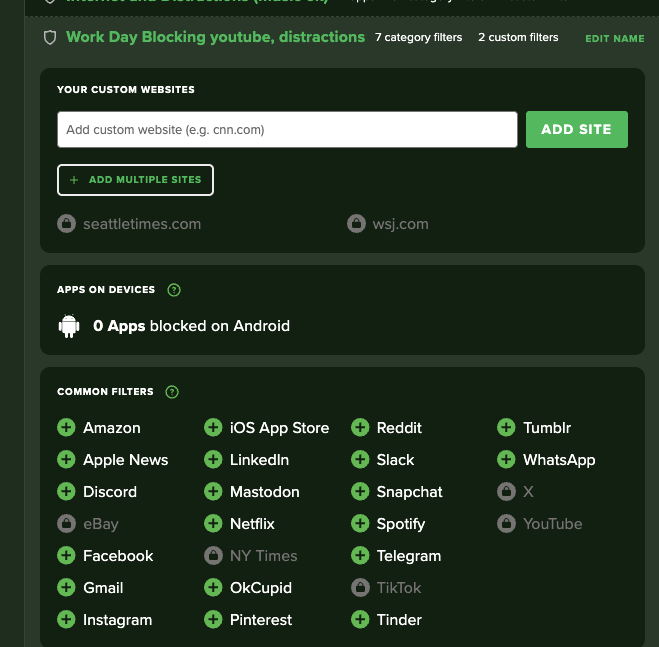
Next, install Freedom.to. This one is really a game-changer because you can set time-based sessions to block lists of apps and websites when you don’t want to use them. I do this at bedtime so I don’t stay up late wasting time on Youtube, etc. Set up lists and blocking sessions for any time of day so that you can focus on what you really want to do with your time.
I purchased the lifetime subscription option for both apps. It’s the best money I’ve ever spent on digital goods.
Remove nonessential notifications, pop-ups,
Use Minimalist phone to hide/block notifications for various services. I do this for text messages, social media, Amazon, and anything else where real-time notifications are completely unnecessary and an invitation to waste time.
I also use messages.google.com on my laptop to receive SMS messages on my laptop. You can do the same thing for WhatsApp, Facebook Messenger, Google Chat, etc. I like bucketing the hours I check nonessential texts to my work day hours on the laptop, unless I intentionally check them on my phone by opening the Messages app.
I have a separate app I use with people I message frequently and see in the physical world like family, neighbors, and close friends for ‘essential’ messages, and I keep notifications on for this app.
Tell people to call you if they need a response ASAP to make up for the fact that you won’t be constantly keeping up with text threads throughout the day. Speaking to someone is a much more fulfilling method of conversation anyway!
Control your laptop/ipad
Use Freedom.to on your laptop as well, including your work one. Set a specific list of filters for work day sessions.
Control your smart TV
Uninstall apps on your smart TV/Amazon Firestick and set up PINs/parental controls. Or, dump your remote control(s) or Firestick into a timed lock box that only unlocks on, say, weekends or whenever you allow yourself to use them.
Here’s some strategies (from AI) for removing Youtube– as an example– from your smart TV:
Non-screen vices
Strategies for moderation
Invest in timed lock boxes like those by Ksafe (I recommend a clear, large one to fit the most stuff), or this small one for phones/small things, that you can dump phones, video game controllers, drugs, alcohol, credit cards, snacks, or keys that go to locks– like if you wanted to lock your refrigerator, or a cabinet full of snacks, to avoid eating close to bedtime.
You set the timer and lock your stuff inside. Now you are forced to go without those things until the time is up and it unlocks. It’s a great way to space out your vices and only have them on weekends, say, or whenever works best for you.
Strategies for abstention
If you don’t ever want to do certain things, don’t let them inside your house or go near the places where you can do them! I have zero willpower if unhealthy food is around me, so I need to keep it out of my house in the first place: don’t go down the grocery store aisle where it lives, don’t put it in your shopping cart, and don’t bring it into your home. If it’s in your home, hide it somewhere hard to get at, or ask your spouse or roommates to lock it up where only they have they key.
Encourage guests or family members not to bring, say, desserts into your home without promising to take them away with them when they leave. Don’t go to the weed store or buy booze if you don’t want to use it/drink it. Stay away from bars or other places where you can buy booze if you don’t want to drink at all.
If you gamble, many casinos let you ‘self-ban’. Or, you can at least limit your habit by asking a casino not to let you cash checks, or leaving credit cards at home and only bringing the amount of cash you wish to lose with you.
Substitution of better alternatives
Substitute the things you don’t want for things that still scratch the itch. I don’t drink alcohol very much these days, but I’ve found non-alcoholic beer gives me a lot of what I love about beer: it’s cold, carbonated, tastes (mostly) like ‘real’ beer, and doesn’t give me a hangover or make me feel drowsy after having one. Plus, you can drink one in the car! Maybe a weekly poker game with your buddies would let you gamble at low cost without the casino’s cash-crushing rake.
If you’re trying to cut down on caffeine, whole bean decaf coffee is close to the real thing. If you’re missing the dopamine hit of entertaining screen time, try podcasts, radio plays, the radio, or reading a book/Kindle (get thee to a library!)
I love movies, but still find myself struggling at night after a long day of work & kids to have the attention span to watch one vs short-form garbage youtube content, so blocking youtube helps me have more ‘quality’ screen time. Better entertainment time is a win for me.
Avoid temptation and reduce risk with good habits
Sweet Jesus!
For risks that aren’t rooted in physical items or substances, avoid being in a risky situations. For couples, follow the Mike Pence/Billy Graham rule: don’t consume alcohol in a co-ed group– and certainly 1:1– without your spouse. Avoid 1:1 social meetings with members of the opposite sex– or at least, not in private. Pence’s rule was to avoid 1:1 meals with a woman, specifically, in addition to avoiding alcohol without his wife around.
Rules like these are the classic technique of working backwards: start from where you do not want to end up, think about how people commonly get there, and then avoid the behaviors that lead to it.
How do workplace extramarital affairs start? With private, 1:1 meetings, often with alcohol, and spending a lot of time with a member of the opposite sex that you’re attracted to. Avoid those meetings from the outset!
How many stories have we heard about men and women cheating on their spouses with close associates like campaign managers, personal assistants, or other confidants, or after a boozy outing with the ‘boys’ or ‘girls’ chatting up a member of the opposite sex in relative privacy?
How do people get DUIs? They drink too much and have access to their cars. A friend of mine who tends to over-drink when he goes out always makes sure to Uber to the bar. Because of this, he has no possible way to make his night worse by driving drunk, and simply Ubers back at the end of the night.
How do most people get hurt in motor vehicle accidents? By not wearing seatbelts, driving drunk (or getting hit by a drunk driver), speeding, or riding motor cycles (or at least, without proper safety gear and precautions like a helmet and tough clothes.)
How do people drown? By not wearing life jackets at all times (85-87% of people who drown were not wearing life jackets.) How do people get lost in the woods and die of exposure? By wandering off trails and failing to have the 10 essentials on them for every hike or backpacking trip.
How do people get hurt by violence? By being around violent actors: a domestic partner who has hit you or your child before, or threatened you with violence. Getting drunk around men (it’s usually men!) you can’t trust completely. Or by being in the middle of people who will behave irrationally: bars at closing time, street ‘takeovers’, while committing crimes or in a high-crime area (ex: inner city gas station) at a high-crime time (ex: late at night.)
Avoiding temptation and risk is much easier than resisting it right in front of you.
Investment accounts allow you to borrow ‘on margin’ at rates above the Federal funds rate. I’ll discuss how margin loans work at Altruist.com, the investment platform where I manage my clients’ & my family’s assets.
Margin borrowing
You can borrow against the value of your securities at these rates. Altruist currently charges +2.5% above the Federal Funds rate (~3.75% as of August 2026, so 6.25 % interest total) for loans up to $50,000, +2.25% for loans $50 K – $100 K, and +2% for loans between $100 K – $1 million. So far as I can tell, Altruist doesn’t charge any origination or other fees to use margin. (They charge $25 if they have to sell securities due to a margin call.)
Potential benefits of margin borrowing
If you are strapped for cash but don’t want to sell securities– perhaps to avoid taxes– and other financing alternatives are unavailable or too expensive for you (e.g.: HELOCs, personal loans, mortgage equity loans), then margin borrowing might provide a more cost-effective alternative.
Risks of margin borrowing
Margin calls if the market declines
If the market declines, you will get a ‘margin call’ where you must invest extra cash to avoid having your securities sold (presumably at a loss relative to when you started borrowing.) This can have a catastrophic cascading effect where you have to sell securities at a loss to bring cash, but you don’t HAVE cash because that’s why you were borrowing in the first place!
To avoid this, keep the percentage that you’re borrowing to at least half of the maximums allowed so that you can weather a 50% decline in stock market prices before being required to put up more cash.
Interest rate fluctuations
Because the rates charged are based the Federal funds rate, increases in that rate will increase your borrowing costs.
Historical Federal Funds Target Rate (1980–Present)
Key monetary policy cycles, emergency cuts, and inflation tightening eras.